Simple Morning Meditation: Set Your Intention · 4:49 min
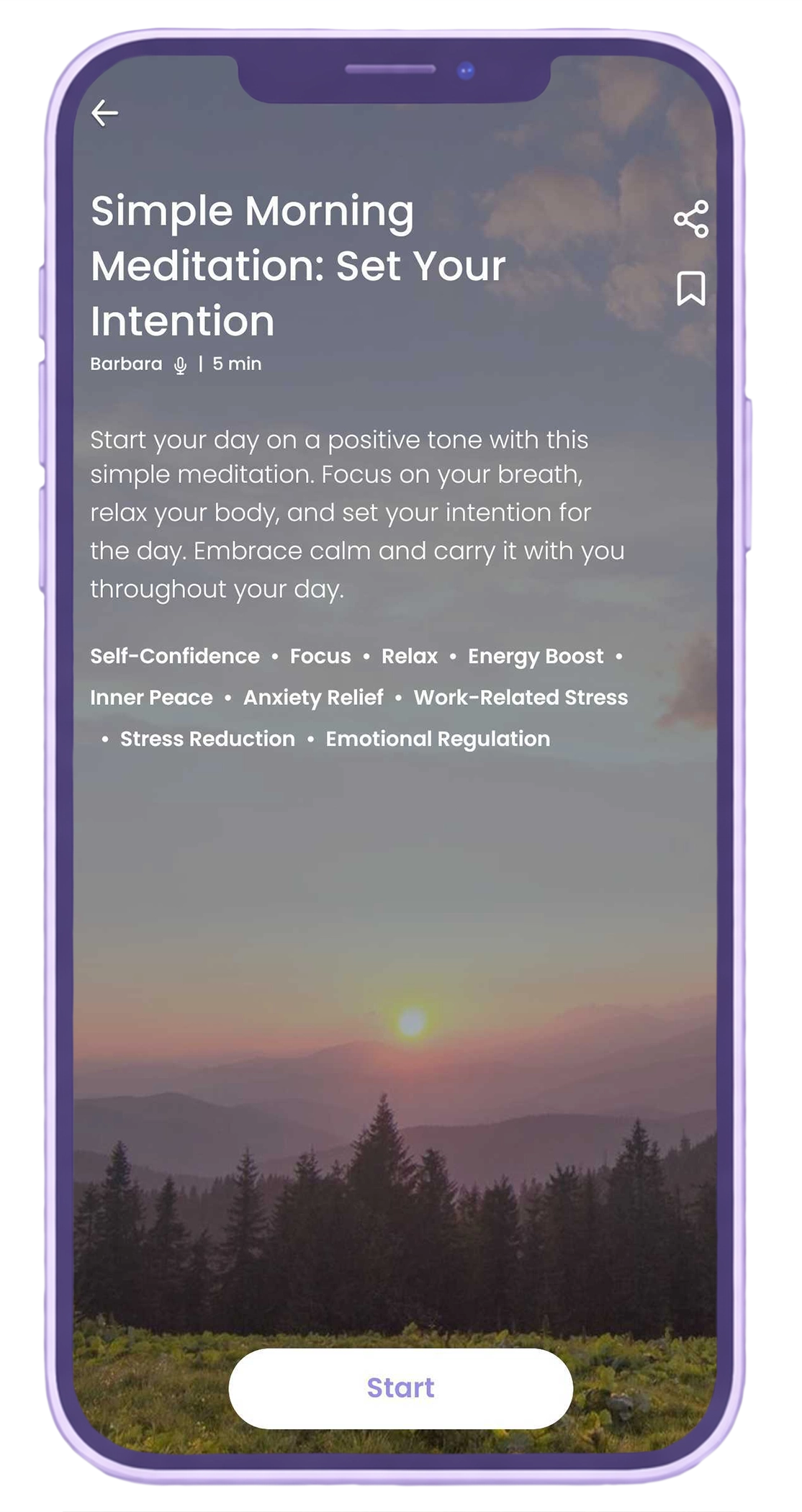
Focus on your breath, relax your body, set one intention for the day. The simplest and most accessible morning practice in Begin. The best starting point for absolute beginners.
Most people who want to meditate don't know where to start. And most people who start don't stick with it — not because meditation doesn't work, but because the format doesn't fit real life. Sessions that are too long. Language that feels spiritual when you want something practical. A single approach when different moments of your day call for completely different things.
Begin's Meditation section is organized around when you're using it: morning, to set the tone before the day takes hold; daytime, to reset, regulate, and refocus when things go sideways; and self-guided, for those who want to meditate without a narrator. Every session is short — between 3 and 8 minutes.
You don't need experience. You don't need a particular belief system. You need five minutes and somewhere to sit.

The Meditation section in Begin has three tabs, each designed for a different time of day and purpose.
Short morning practices that establish a mental baseline before the day begins. Most sessions combine breathwork with intention-setting, visualization, or affirmations. They're designed to be done before you check your phone — which is the single highest-leverage habit change in Begin.
Focus on your breath, relax your body, set one intention for the day. The simplest and most accessible morning practice in Begin. The best starting point for absolute beginners.
Specifically for morning anxiety — the kind that arrives before you've even fully woken up. Breathing followed by visualization to release tension before it builds into the day.
Breathe, then visualize yourself smoothly completing the tasks ahead. A mental rehearsal that reduces anticipatory anxiety and builds confidence before hard work.
Also in this section: Morning Energizing Practice (4:20 min) · Morning Mood Boost (4:15 min) · Morning Ritual for Better Decisions (6 min) · Morning Breathing for Calm and Focus (5:50 min) · Positive Morning Meditation (4 min) · Calmness with Ocean Breath (4:45 min) · Confident Morning Meditation (4:47 min) · Wake Up Your Body and Mind (7 min) + more
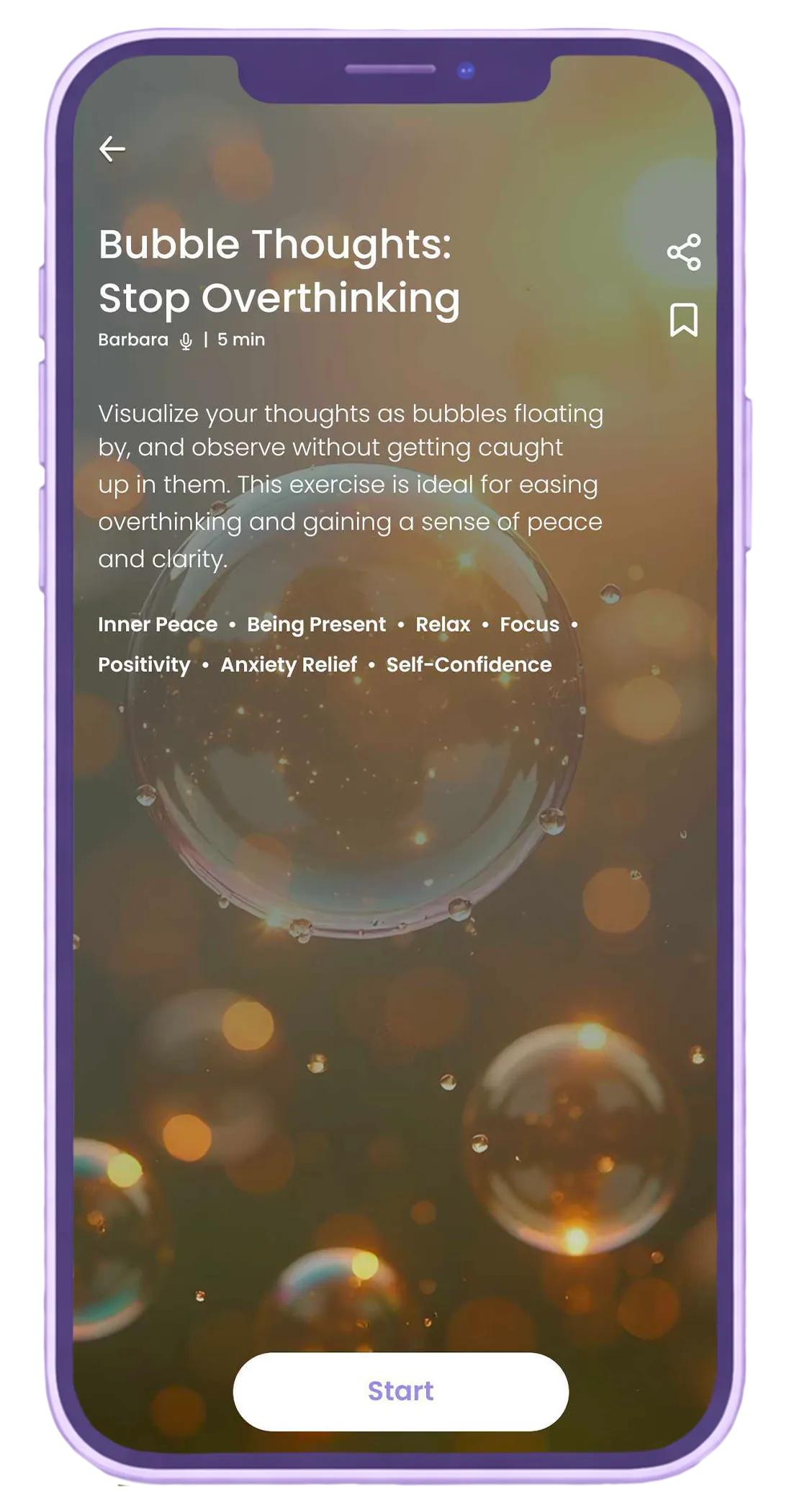
Midday and afternoon sessions for specific situations: stress that's already there, focus that's disappeared, emotions that are running high, or the need to transition between different types of work. Sessions range from 3 to 8 minutes. No warm-up required.
Visualize each thought as a bubble — watch it float past without grabbing onto it. For the mental loops that make it hard to focus, rest, or make decisions. One of the most used sessions in Begin for people whose primary problem is a mind that won't slow down.
Recognize, Allow, Investigate, Nurture — a four-step approach drawn from clinical mindfulness practice for moments when a strong emotion (anger, anxiety, shame) is making it difficult to think clearly. Doesn't suppress the feeling; creates space around it.
Mindful nasal breathing designed for the transition from work mode to home mode — releasing the residue of the day before you walk in the door or sit down with family. Most effective when done before re-entering domestic life, not after.
Picture thoughts as leaves on a slow stream — they pass, you don't follow them. Based on Acceptance and Commitment Therapy (ACT), which has a strong evidence base for reducing rumination. A more passive technique than Bubble Thoughts — good for people who find active visualization effortful.
Also in this section: Reset Your Focus in 3 Minutes (3:16 min) · From Monkey Mind to Inner Peace (5:14 min) · Quick Focus Meditation (4:15 min) · Quick De-Stress Meditation (5:34 min) · Quick Focus Reset (2:53 min) · Deep Focus: Improve Concentration (7:31 min) · Quick Tapping for Calmness and Focus (4 min) · Tapping Meditation to Calm Anxiety (7 min) · Build Self-Esteem (5 min) + more
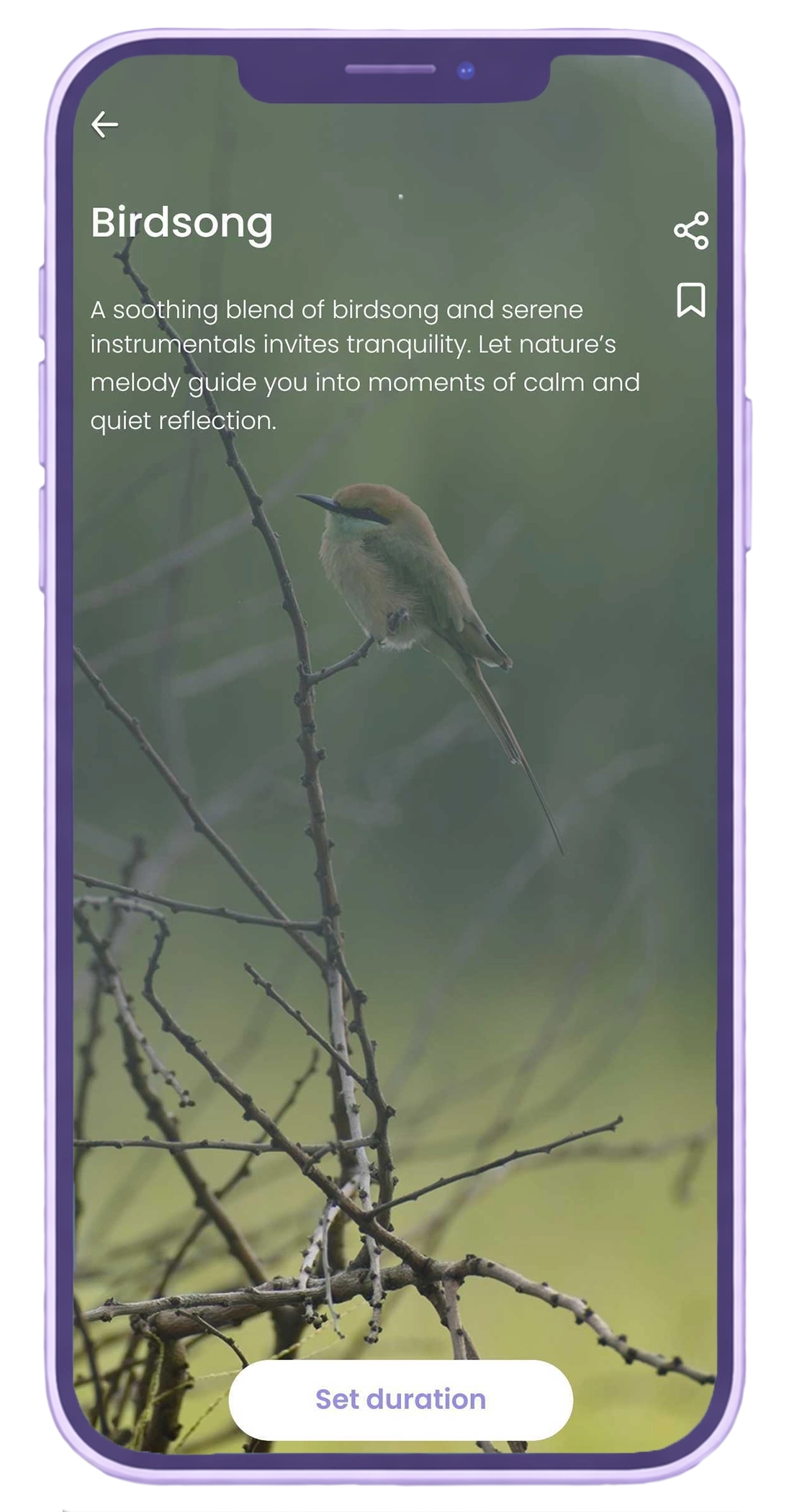
For users who want to meditate without being narrated. Five ambient soundscapes serve as the only anchor — you sit, breathe, and observe, without instruction. This tab is designed for people who already have some experience, or who want to develop a silent sitting practice alongside the guided sessions.
The resonant ring of singing bowls sustained over time. A traditional sound anchor for meditation — the tone gives attention something to return to when the mind wanders.
Natural birdsong in a calm outdoor setting. One of the most universally accessible self-guided anchors — works for people who find artificial or tonal sounds difficult.
Low-frequency binaural tones in the theta range, associated in neuroscience literature with deep relaxation and light sleep. Intended as an ambient environment for extended self-guided sessions. Best with headphones. Individual responses vary.
Also available: Binaural Tones (general) · Mantra (Om)
A landmark Harvard study by Killingsworth and Gilbert (2010) found that the human mind is wandering 46.9% of waking hours — and that a wandering, self-referential mind is consistently associated with lower wellbeing. The brain's default mode network (DMN), active during mental idling, is the neurological seat of rumination, worry, and self-critical thought. Mindfulness meditation is among the most studied interventions for reducing DMN overactivity.[1][5]
A 2010 meta-analysis in the Journal of Consulting and Clinical Psychology (Hofmann et al.) reviewed 39 studies of mindfulness-based therapy and found significant improvements in anxiety and depression symptoms across clinical and non-clinical populations. The effects were most consistent when participants practiced regularly — even briefly — rather than in occasional longer sessions.[2]
Mornings matter more than most people expect. Cortisol follows a natural awakening response in the first 30–45 minutes after waking — it rises sharply as part of the body's preparation for the day. Research suggests that how you use this window can influence mood, stress reactivity, and cognitive performance for hours afterward. Begin's Morning sessions are designed specifically for this period: brief enough to fit into any morning, and focused enough to set a deliberate direction rather than letting the day start by default.[6]
The Daytime sessions address a different mechanism. By midday, the prefrontal cortex — responsible for attention regulation, decision-making, and emotional control — accumulates what researchers call 'decision fatigue' and attentional depletion. Short mindfulness practices during the day have been associated with partial restoration of these cognitive resources. A 2018 meta-analysis in Psychological Bulletin found that brief mindfulness interventions (under 10 minutes) produced meaningful reductions in anxiety and negative affect — a finding directly relevant to Begin's 3–8 minute daytime sessions.[3]
EFT tapping (used in Quick Tapping for Calmness and Focus and Tapping Meditation to Calm Anxiety) combines elements of exposure therapy with acupressure-point stimulation. Multiple RCTs have found EFT associated with reductions in anxiety and cortisol, though the evidence base is still developing and proposed mechanisms remain under investigation.[4]
Simple Morning Meditation: Set Your Intention. Do it before checking your phone. This is the cleanest entry point because it anchors to a fixed time.
Reset Your Focus in 3 Minutes or Bubble Thoughts. Use this when focus has disappeared or mental loops are taking over.
Unwind After Work. Use it as a deliberate threshold between work mode and home mode, before you re-enter domestic life.
Start with Tibetan Bowls or Birdsong. Set a timer for 5 minutes. When your mind wanders, return to the sound. That's the entire practice.
Tapping Meditation to Calm Anxiety. The physical element can be useful precisely when stillness feels impossible.
Developed with Diana Rodrigues — Yoga, Meditation & Breathwork Specialist
BSc Communication Sciences · 1,500+ hours formal training in yoga, breathwork & meditation · Physiotherapy assistant background · BSc Psychology (2026)
View full profile →Before you check your phone, open Begin. Tap Meditation → Morning → Simple Morning Meditation. Do it once and decide from there.
Try it for FreeMind-wandering is not a sign that meditation isn't working — it's the mechanism through which it works. Every time you notice your mind has wandered and bring it back, you've done one repetition of the attention-training exercise. Begin's sessions, particularly Deep Focus: Improve Concentration (7:31 min) and Reset Your Focus in 3 Minutes (3:16 min), are designed precisely around this: the wandering is expected, the return is the skill.
Many people notice something within their first session — a sense of calm or slightly more settled attention within the practice itself. Longer-term changes (a quieter baseline, fewer intrusive thoughts, better stress recovery, improved focus) tend to become noticeable with consistent practice over 2–4 weeks. Research suggests short daily sessions are more effective than occasional long ones: 5 minutes every morning is a better foundation than 30 minutes once a week.
Both, ideally — for different purposes. Morning meditation (specifically before checking your phone) works with the cortisol awakening response and sets a deliberate tone for the day. Daytime sessions address what's happening in the moment: stress, distraction, emotional overload. If you can only do one, start with morning — the habit anchors more reliably to a fixed time.
Morning sessions are proactive — they're about setting up your mental state before the day begins. Daytime sessions are reactive — they're designed for specific moments: when you need to reset focus, when a strong emotion has taken over, when you want to decompress after work. Morning sessions tend to use more visualization and intention-setting; Daytime sessions lean toward thought-observation techniques and emotional regulation tools.
No. Begin's sessions can be done seated on a chair with your feet on the floor, lying down (though this increases the chance of falling asleep), or anywhere you can remain still for a few minutes. The position matters less than the consistency. If you find yourself doing 4:49 of Simple Morning Meditation at your kitchen table before coffee, that's exactly right.
Self-guided meditation uses only an ambient sound (Tibetan Bowls, Birdsong, Theta Waves, or similar) as an anchor — there's no narration. You set a timer, sit, and observe. It's appropriate for people who have some familiarity with meditation and want to develop a practice without always following a voice, or who find narration distracting once they know what to do. If you're completely new, start with the guided sessions and return to Self-Guided after a few weeks.
