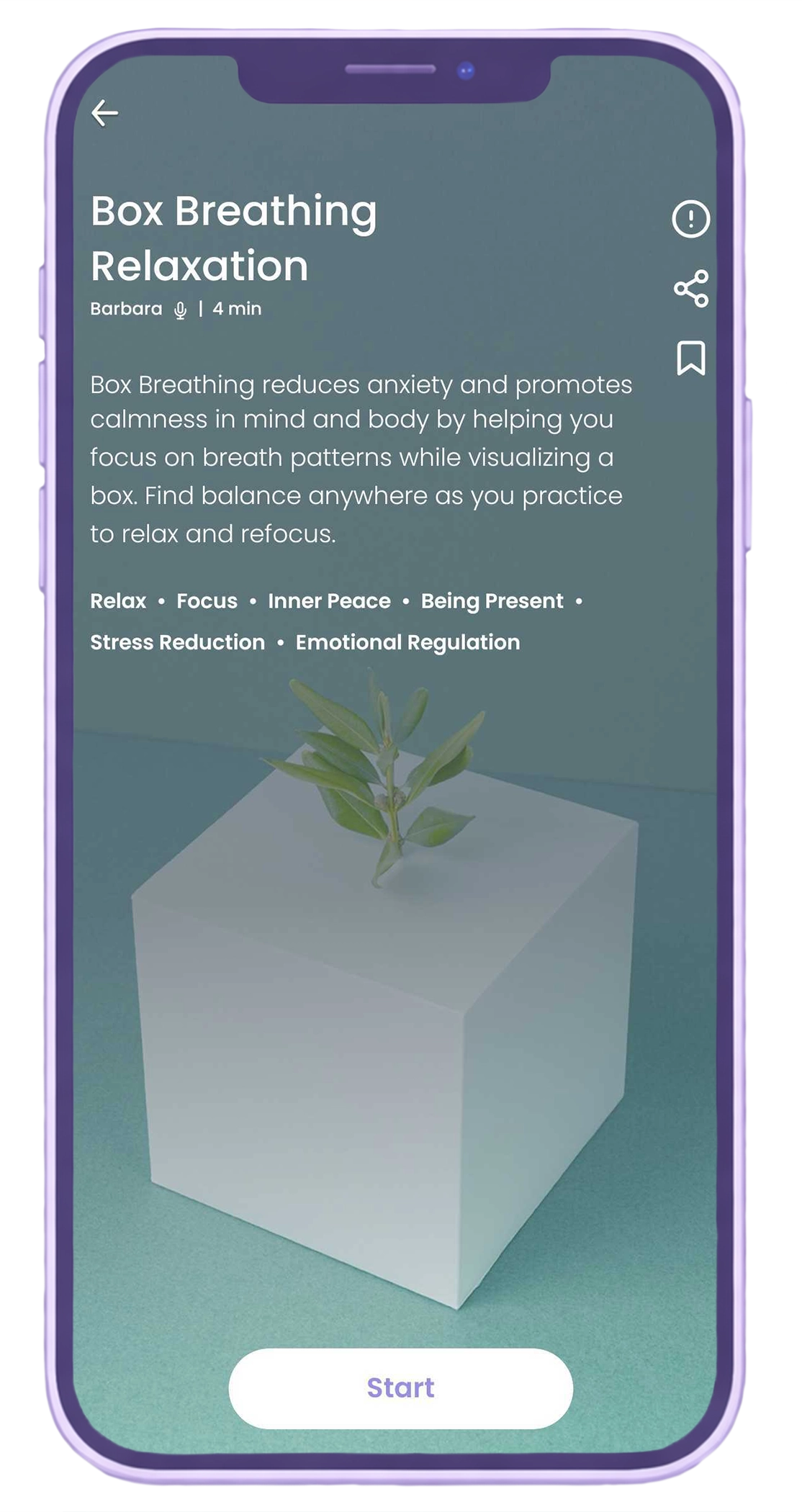
Box Breathing Relaxation · 4 min
Visualize a box being drawn as you breathe: 4 seconds in, 4 hold, 4 out, 4 hold. Repeat. Used by Navy SEALs to stay calm under pressure — and just as effective for a hard conversation at work.
Your breathing is one of the most direct ways to influence your nervous system voluntarily. Stressed? Anxious? Scattered? Slowing and pacing your breath can help shift your body toward a calmer state — often within a few minutes, without any prior experience.
The problem is knowing which technique to use, when to use it, and how to actually do it correctly. That's exactly what Begin's breathing section is built for.
When you open the Breathing section in Begin, you'll find two tabs:
Seven audio-guided sessions, each with a synchronized on-screen visual animation that shows you exactly how to breathe — when to inhale, when to hold, when to exhale. You don't need to count in your head. The animation does it for you.
Sessions range from 4 to 5 minutes and can be done anywhere — at your desk, in the car before a meeting, or lying in bed.
Visualize a box being drawn as you breathe: 4 seconds in, 4 hold, 4 out, 4 hold. Repeat. Used by Navy SEALs to stay calm under pressure — and just as effective for a hard conversation at work.
Inhale for 4, hold for 7, exhale for 8. The extended exhale may support parasympathetic activity and help slow physiological arousal when repeated over several cycles. Particularly effective as part of a wind-down routine before sleep.
Inhale for 5 seconds, exhale for 5 — steady and slow. This rhythm is associated with increased heart rate variability (HRV), a marker of autonomic flexibility and stress resilience. Useful before deep work or demanding situations.
Also in this section: Belly Breathing (4 min) · Star Breathing (5 min) · Alternate Nostril Breathing for Balance (5 min) · Humming Bee Breathing for Tranquility (5 min)
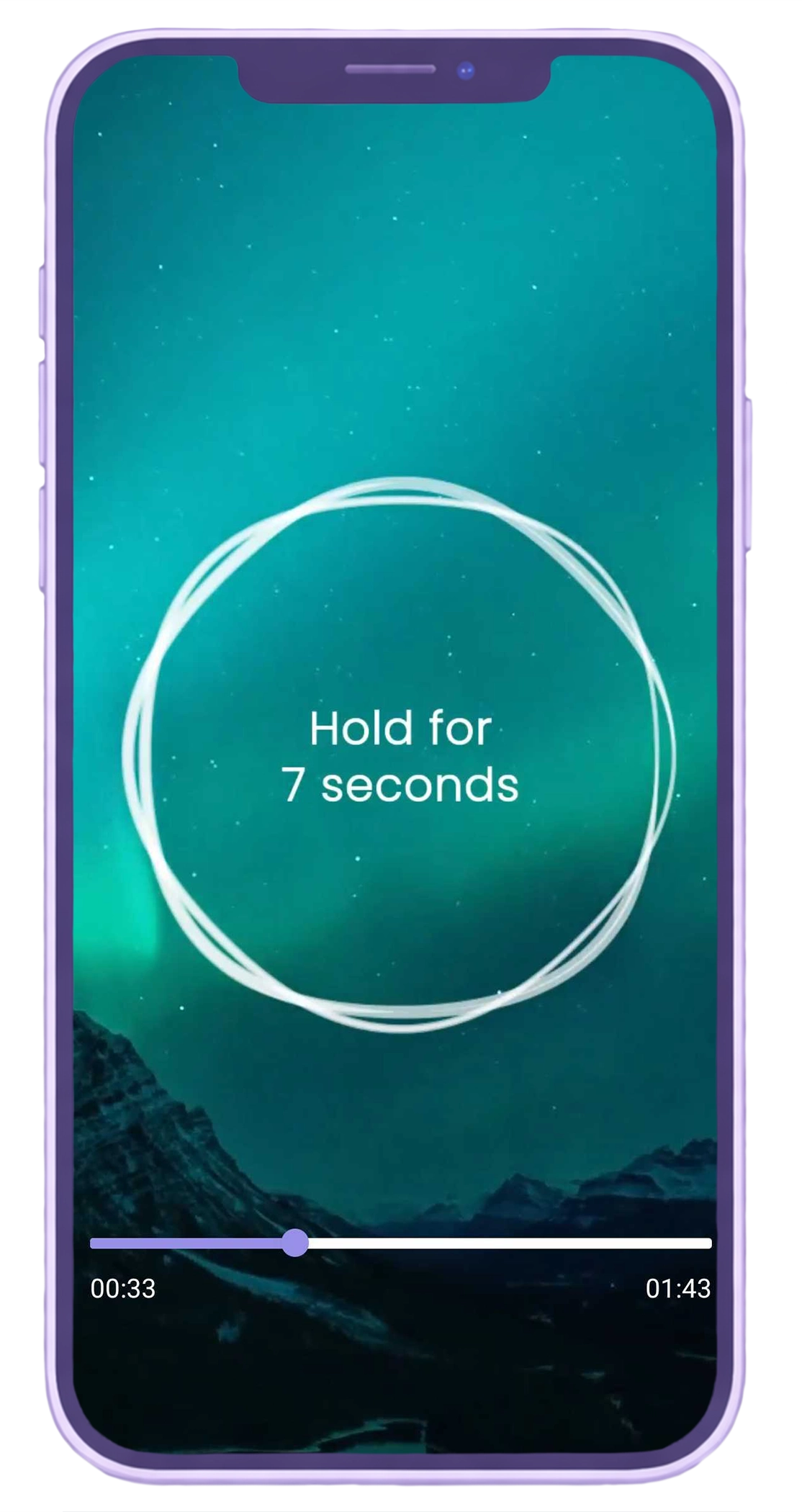
The same seven techniques, distilled into 1:44–2:08 minute visual-only sessions. No audio guide — just the animated visual prompt. Perfect for situations where you can't use sound (a meeting, public transport, a waiting room) or when you already know the technique and just need the timer.
These are some of the only breathing tools on the market that are designed to work without audio at all. The animation is the guide.
Your breathing is one of the few autonomic functions you can voluntarily influence. Changing your breathing pattern can help shift the body toward a calmer state — research suggests this works through multiple pathways, including heart rate variability and the interplay between the sympathetic and parasympathetic nervous systems.
Technique 01
4 - 4 - 4 - 4
Breathing is one of the few autonomic functions you can voluntarily influence. Changing your breathing pattern can help shift the body's stress response — research suggests this works through multiple pathways including heart rate variability, respiratory sinus arrhythmia, and the interplay between the sympathetic and parasympathetic nervous systems.
Best for: acute stress · pre-meeting nerves · exam anxiety
Technique 02
Inhale 4 - Hold 7 - Exhale 8
The 4-7-8 technique works by making the exhale longer than the inhale. Heart rate tends to slow on exhalation; extending that exhale may amplify this effect over repeated cycles. It's used by many practitioners as a pre-sleep wind-down tool, though the precise mechanism is still being studied.
Best for: falling asleep · stopping a panic response · evening wind-down
Technique 03
Double inhale → Long exhale
Humming bee breathing (Bhramari) has been studied specifically for its effect on nitric oxide production in the nasal sinuses — a 2002 study found that humming significantly increases nasal nitric oxide, which may improve airway function and support parasympathetic activation.
Best for: instant mid-day relief · before a difficult conversation
Technique 04
5 seconds in - 5 seconds out
Coherent breathing at 5 seconds in / 5 seconds out has been associated in multiple studies with increased heart rate variability — a marker of cardiovascular resilience and autonomic flexibility. It's used in anxiety reduction protocols and sports performance training, though effects vary between individuals.
Best for: daily practice · emotional regulation · long-term nervous system training
Before a high-stakes meeting or presentation: Box Breathing (4 min guided, or 1:44 quick exercise). The symmetrical pattern grounds you without sedating you.
Most breathing apps play audio and tell you to 'breathe in... breathe out.' Begin's sessions pair audio guidance with animated visual cues synchronized to each breath. You're not counting in your head, you're watching the shape expand and contract, which makes it significantly easier to maintain the correct pattern, especially if your mind is already busy.
Every session in Begin can be done anywhere, any time of day. The Quick Exercises require no audio whatsoever, useful in offices, transit, or anywhere headphones aren't practical. And each session is short enough that 'I don't have time' genuinely isn't true.
Developed with Diana Rodrigues — Yoga, Meditation & Breathwork Specialist
BSc Communication Sciences · 1,500+ hours formal training in yoga, breathwork & meditation · Physiotherapy assistant background · BSc Psychology (2026)
View full profile →Change how you feel in the time it takes to make a cup of tea. Download Begin, open Breathing → Guided, and tap Box Breathing Relaxation. You'll feel the difference before the session ends.
Try it for FreeBox Breathing is Begin's most universal starting point. It's symmetrical, easy to follow with the visual guide, and effective within 2–3 breath cycles. If you've never done breathwork before, open Begin, go to Breathing → Guided, and tap 'Box Breathing Relaxation.' Four minutes later you'll understand why it works.
No. Begin's Quick Exercises (Tab 2 in the Breathing section) are entirely visual — they use animated guides with no audio. You can use them in complete silence. The Guided sessions (Tab 1) work with headphones or phone speaker.
Even once a day makes a measurable difference. Begin's most consistent users tend to do one 4-minute session in the morning (often Coherent Breathing) and one quick exercise whenever stress spikes during the day. You don't need to schedule it — it's four minutes. You can do it anywhere.
Research suggests yes — slow, paced breathing is associated with reduced self-reported anxiety and shifts in autonomic markers including heart rate and HRV. In Begin, the sessions most targeted at anxiety are Star Breathing, 4-7-8 Breathing to Unwind, and Humming Bee Breathing for Tranquility. Many users find they notice a shift within a few minutes. Individual responses vary.
Guided sessions (4–5 min) include audio narration from Barbara plus a visual animation. They walk you through the technique from scratch, making them perfect if you're new or want full guidance. Quick Exercises (under 2 min) are visual-only — just the animation, no audio. They're designed for situations where you already know the technique and need a fast, silent prompt.
Yes — Begin has a dedicated Kids Breathing section with 7 sessions using animal-themed techniques: Bubble Breathing, Dragon's Breath, Bunny Breath, Bear Breathing, and more. All sessions are guided by Luna, Begin's kids voice. See the /kids page for details.
