Simple Morning Meditation: Set Your Intention · 4:49 min
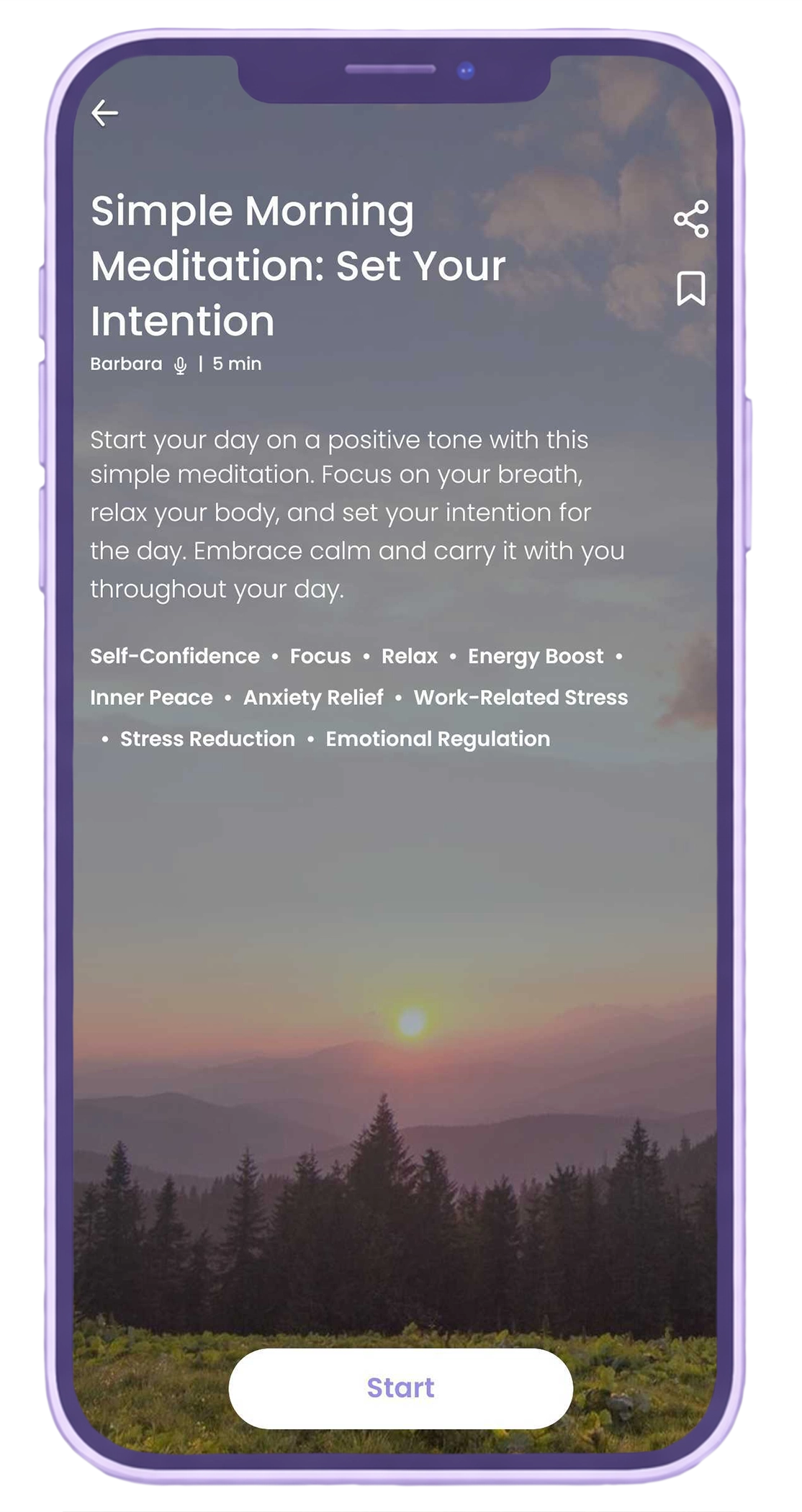
Focus on your breath, relax your body, set one intention for the day. The simplest and most accessible morning practice in Begin. The best starting point for absolute beginners.
Your mind doesn't stop. You replay conversations. You plan things that haven't happened yet. You worry about things that probably won't. You're exhausted, but your brain keeps going. This is not weakness. It's what minds do, especially sharp, hard-working minds. The question is whether you have any influence over it.
Begin's meditation section is built for people who think too much and feel like they don't have time to sit still. Shortest session: 3 minutes. Longest: 8 minutes. All designed to give you a practical tool for a specific type of mental noise.

The Meditation section in Begin has three tabs built for morning routines, daytime resets, and self-guided calm.
Short morning practices designed to set the tone before the day takes over. Includes guided breathing, intention-setting, positive affirmations, and visualization. Most sessions are 4-5 minutes. None of them require you to be spiritual, experienced, or particularly calm when you start.
Focus on your breath, relax your body, set one intention for the day. The simplest and most accessible morning practice in Begin. The best starting point for absolute beginners.
Specifically for morning anxiety — the kind that arrives before you've even fully woken up. Breathing followed by visualization to release tension before it builds into the day.
Breathe, then visualize yourself smoothly completing the tasks ahead. A mental rehearsal that reduces anticipatory anxiety and builds confidence before hard work.
Also in this section: Morning Energizing Practice (4:20 min) · Morning Mood Boost (4:15 min) · Morning Ritual for Better Decisions (6 min) · Morning Breathing for Calm and Focus (5:50 min) · Positive Morning Meditation (4 min) · Calmness with Ocean Breath (4:45 min) · Confident Morning Meditation (4:47 min) · Wake Up Your Body and Mind (7 min) + more
Midday and afternoon sessions for when the day has gone sideways, when focus disappears, or when you need to transition between different kinds of work. Ranges from 3 to 8 minutes.
Visualize thoughts as bubbles floating past — observe them without getting caught up. One of the most effective sessions in Begin for people whose primary problem is mental loops. The visual metaphor makes the skill concrete and immediately usable.
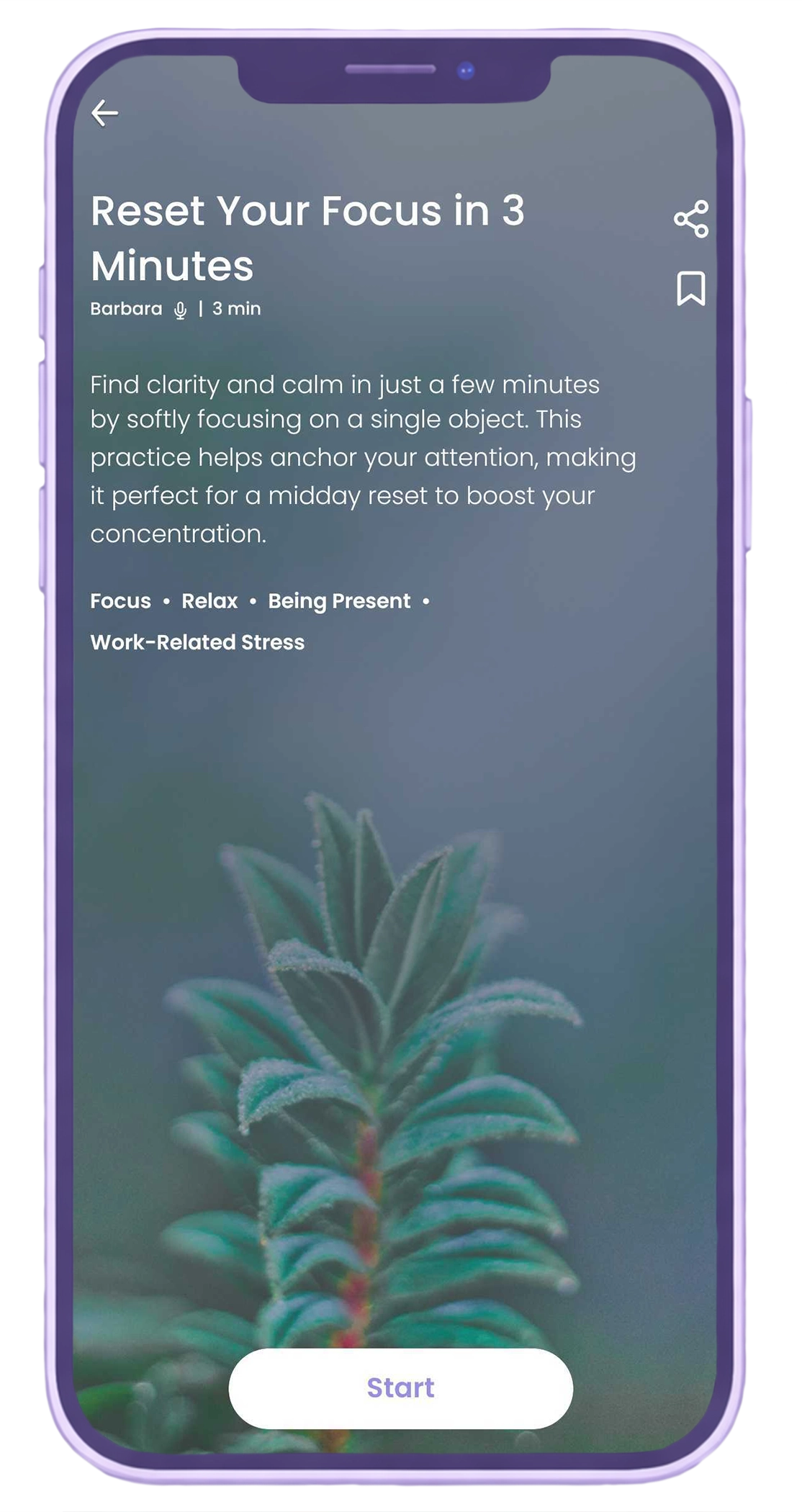
Softly focus on a single object for three minutes. The simplest possible mindfulness technique — and one of the most effective for immediate focus recovery.
Recognize, Allow, Investigate, Nurture — a four-step approach to emotional regulation. For moments when a strong emotion (anger, shame, grief) is making it impossible to think clearly.
The transition from work mode to home mode. Mindful nasal breathing designed to release work tension and shift mental gears. Most effective done before you leave the office or immediately after arriving home.
Also in this section: Leaves on a Stream (6:50 min) · From Monkey Mind to Inner Peace (5:14 min) · Quick Focus Meditation (4:15 min) · Quick De-Stress Meditation (5:34 min) · Quick Focus Reset (2:53 min) · Deep Focus: Improve Concentration (7:31 min) · Quick Tapping for Calmness and Focus (4 min) · Tapping Meditation to Calm Anxiety (7 min) + more
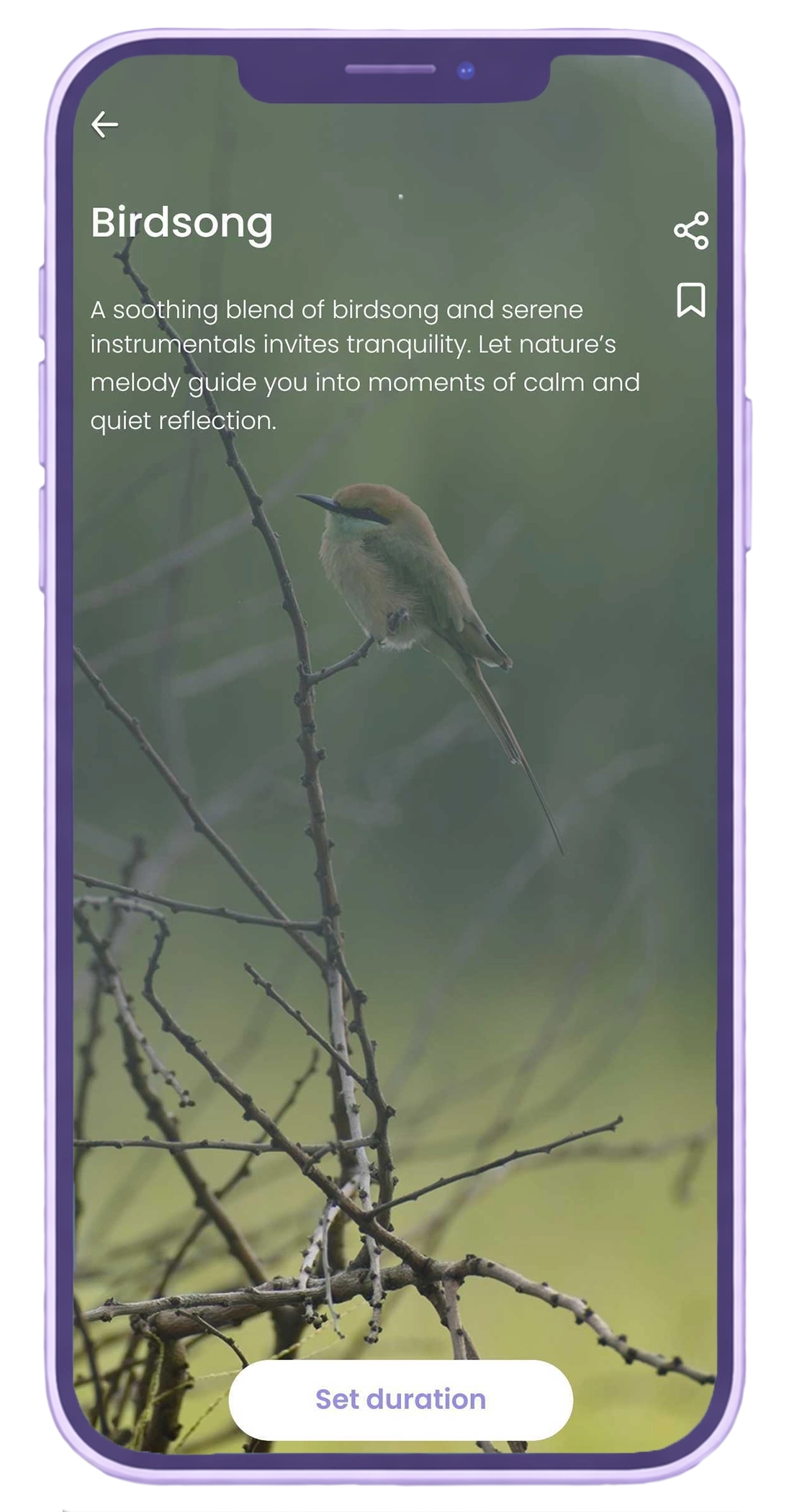
Ambient soundscapes for meditation without narration — for users who want to meditate in silence with just a sound anchor. Includes Birdsong, Binaural Tones, Tibetan Bowls, Theta Waves, Mantra (Om), and more.
Open Begin, choose the sound anchor that fits your mood, and meditate without narration for as long as you need.
Attention training strengthens the ability to notice mind-wandering and return to the present without treating it as failure.
Bubble Thoughts, Leaves on a Stream, RAIN, and quick focus resets target rumination, strong emotions, and mental loops.
Brief practices under 10 minutes are easier to repeat, which matters more than occasional long sessions for building benefit.
A landmark Harvard study by Killingsworth and Gilbert found that the human mind is wandering 46.9% of waking hours — and that a wandering mind is consistently associated with lower happiness.[1]Mindfulness practices are one of the most evidence-based ways to reduce rumination, self-referential thinking, and worry.[2]
Begin's short sessions are not a compromise. The brain changes that underlie long-term benefit accumulate from repeated short exposures, not from occasional long retreats.
Simple Morning Meditation or Morning Calm before checking your phone. Beginning the day with deliberate attention before the scroll changes the tone of the day.
Use Reset Your Focus in 3 Minutes or Quick Focus Meditation when focus slips. If emotions are running high, use RAIN or Bubble Thoughts.
When overthinking at night, use Bubble Thoughts or Leaves on a Stream while sitting upright to reduce the mental load before bed.
Reviewed by Diana Rodrigues — Yoga, Meditation & Breathwork Specialist
BSc Communication Sciences · 1,500+ hours formal training in yoga, breathwork & meditation · Physiotherapy assistant background · BSc Psychology (2026)
View full profile →Yes — and mind-wandering is not a sign that meditation isn't working. It's the practice. Every time you notice your mind has wandered and bring it back, you've done one rep of the attention muscle. Begin's sessions like Deep Focus and Reset Your Focus are designed precisely for this — they treat mind-wandering not as failure but as the mechanism through which the practice works.
Simple Morning Meditation: Set Your Intention (4:49 min, Barbara). It's the most accessible entry point — no prior experience required, no unusual body positions, no unusual concepts. Just breath and intention. Once you've done it three or four times, try Quick Focus Meditation (4 min) for a daytime practice.
Both are metacognitive visualization techniques for managing mental chatter. Bubble Thoughts (5 min, Barbara) is more active — you pop each bubble, which gives anxious or ADHD-type minds something to 'do.' Leaves on a Stream (7 min, Barbara) is more passive — you observe leaves floating by without engaging. Try Bubble Thoughts first; if it feels too effortful, switch to Leaves on a Stream.
Yes — two. Quick Tapping for Calmness and Focus (4 min, Barbara) is a short daytime reset. Tapping Meditation to Calm Anxiety (7 min, Barbara) is a longer, more thorough EFT protocol. EFT (Emotional Freedom Techniques) involves tapping on specific acupressure points while focusing on the issue causing stress — multiple RCTs have found EFT associated with reductions in anxiety, though the evidence base is still developing.
Most Begin users report a difference in their baseline anxiety and focus within 2–4 weeks of daily practice. The immediate effect (calmer within the session) happens from day one. The cumulative effect — a quieter default state, fewer intrusive thoughts, faster recovery from stress — builds over weeks. Consistency matters more than duration: 5 minutes daily outperforms 40 minutes once a week.
Before you check your phone, open Begin. Tap Simple Morning Meditation: Set Your Intention in the Morning tab. Do it once and decide from there. That's all we ask.
Try it for FreeiOS and Android · Free to start · No commitment
